
Quick Overview: The Art of German Christmas Baking
German Christmas cookies, known natively as Plätzchen, rely on specific flour-to-fat ratios, finely milled tree nuts, and historic leavening agents rather than modern baking powder. Authentic varieties require distinct chemical actions from ammonium bicarbonate (Hirschhornsalz) for crisp snap and potassium carbonate (Pottasche) for dense honey expansion.
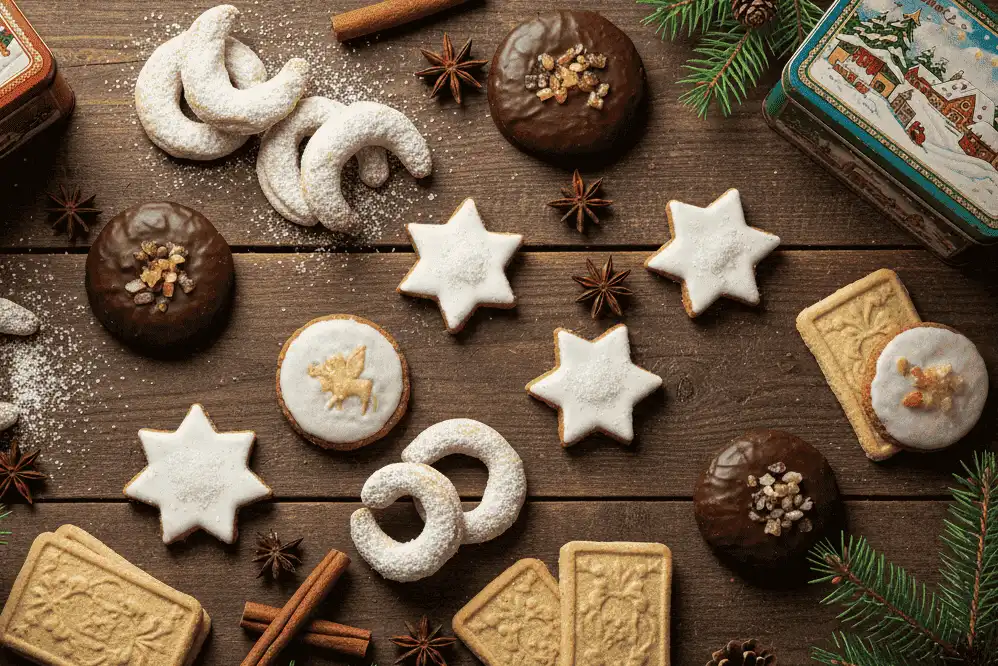
A traditional holiday assortment balances crumbly shortbreads (Mürbeteig), soft nut meringues (Makronen), pressed anise doughs (Springerle), and spiced gingerbreads (Lebkuchen) designed to mature over several weeks in sealed tins.
Holiday baking in Germany is an exact culinary discipline refined over centuries in home kitchens and guild bakeries. Unlike everyday drop cookies, authentic German Christmas cookies require precise temperature management, careful fat handling, and controlled post-bake maturation.
This master guide is designed for home bakers, culinary heritage enthusiasts, and holiday planners seeking repeatable, bakery-standard results. You will learn the exact chemical mechanics, historical techniques, and step-by-step formulas needed to produce authentic German holiday pastries.
The Cultural Tradition of the Weihnachtsbäckerei
The annual German holiday baking season, known as the Weihnachtsbäckerei, begins in late November leading into the first Sunday of Advent. Historically, this intensive baking period was tied to monastic traditions where costly imported spices were combined with preserved honey and nuts to celebrate Saint Nicholas Day and Christmas.
Central to this heritage is the Bunter Teller (colorful plate), a carefully arranged platter presented to guests throughout December. A proper holiday plate provides contrasting colors, aromas, and mouthfeels rather than a single cookie style.
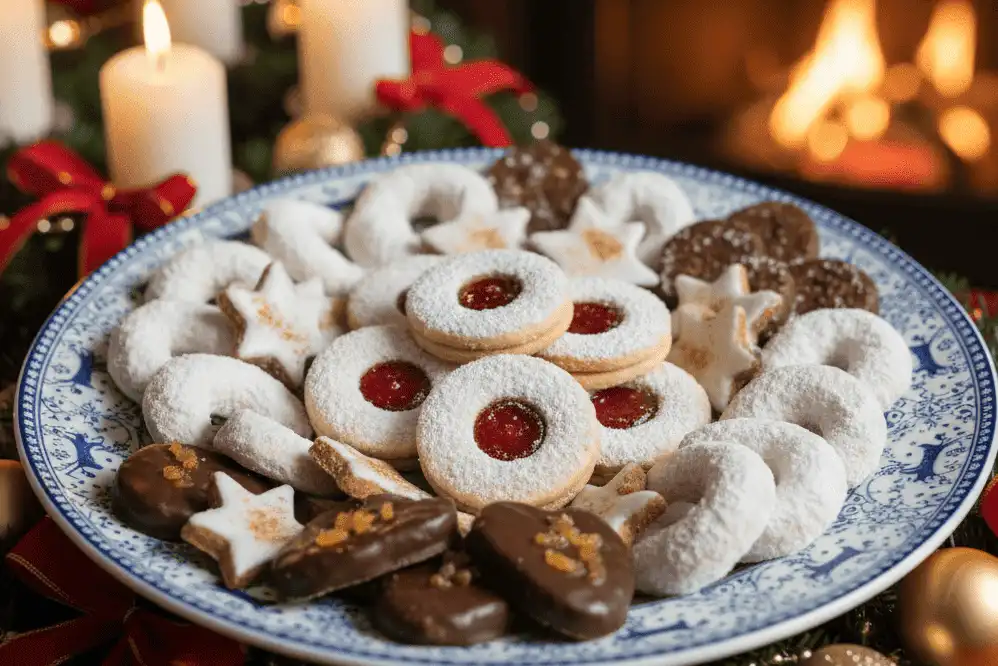
Baking occurs in coordinated stages based on shelf-life and maturation requirements. Sturdy gingerbreads and anise biscuits are baked first to allow weeks of flavor development, while delicate butter shortcrusts are baked closer to Christmas Eve.
Pantry Chemistry: Traditional Leaveners, Spices, and Flours
Achieving authentic textures in traditional German baking requires moving beyond modern Western supermarket standards. The structural integrity and snap of these pastries depend directly on specific chemical reactions.
Historic Chemical Leaveners
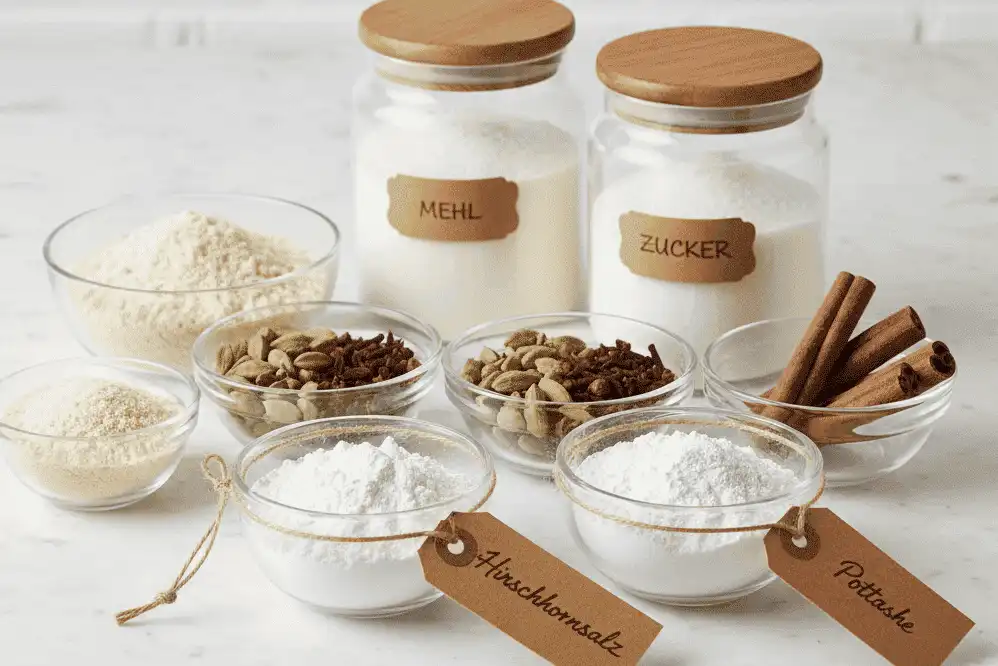
Traditional German recipes rarely use standard baking powder because modern double-acting leaveners create vertical rise and cakey textures. Authentic recipes rely on two specialized leavening salts:
- Hirschhornsalz (Ammonium Bicarbonate): Historically derived from deer antlers, this leavener decomposes at temperatures above 60°C (140°F) into carbon dioxide, water, and gaseous ammonia. It produces an ultra-crisp, light crumb in flat baked goods like Springerle and Spekulatius. Because ammonia gas must escape fully during baking, it should never be used in deep, moist cakes.
- Pottasche (Potassium Carbonate): This alkaline salt is hygroscopic and uniquely suited for heavy, acidic doughs sweetened with honey or molasses. Pottasche softens the strong gluten network of honey doughs and causes them to spread horizontally rather than puff vertically, producing the characteristic chewy density of authentic Lebkuchen.
The Master Lebkuchengewürz Matrix
Pre-packaged gingerbread spice mixes vary widely in quality. Professional German pastry chefs blend their own Lebkuchengewürz based on a precise aromatic hierarchy:
| Spice Component | Percentage by Weight | Functional Role in Dough |
|---|---|---|
| Ceylon Cinnamon | 35% | Sweet, warm base aroma; rounds sharp notes. |
| Ground Cloves | 15% | High eugenol content provides pungent holiday depth. |
| Ground Allspice (Piment) | 10% | Bridges clove, cinnamon, and pepper notes. |
| Ground Nutmeg or Mace | 10% | Provides savory, earthy undertones. |
| Ground Cardamom | 10% | Adds citrus-herbal brightness to cut heavy fats. |
| Ground Ginger | 10% | Supplies clean back-palate heat. |
| Ground Star Anise & Coriander | 10% (5% each) | Provides sweet licorice and floral-citrus lift. |
Flour Classification and Nut Flours
German standard pastry flour corresponds to Type 405, which contains roughly 8.5% to 9.5% protein. This low protein content prevents excess gluten development during rolling, keeping shortbread pastries tender.
Nut flours serve as functional structural bases rather than simple flavoring. Finely ground blanched almonds provide moisture retention and tenderness, while roasted hazelnut meal provides natural structural oils and deep toasted flavors.
The Core Categories of German Christmas Cookies
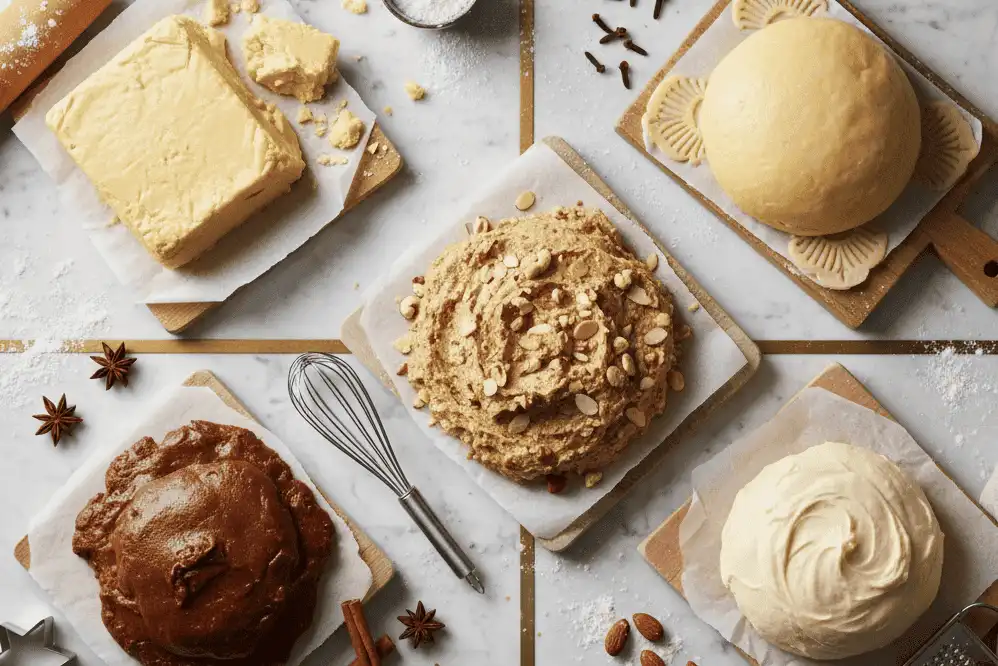
Every traditional German holiday cookie falls into one of five distinct technical dough families. Mastering these families gives bakers complete control over the entire holiday repertoire.
1. Mürbeteig (Shortcrust Doughs)
Shortcrust pastries rely on a 3:2:1 baseline ratio (three parts flour, two parts cold butter, one part sugar). Varieties like Vanillekipferl, Spitzbuben, and Heidesand depend on fast processing to keep butter cold and avoid gluten formation.
2. Makronenteig (Nut Meringue Pastes)
Nut pastes omit grain flour entirely, using whipped egg whites and sugar as structural binders for ground almonds or hazelnuts. Zimtsterne and classic hazelnut macaroons belong to this family, requiring low-temperature baking to preserve a chewy, marzipan-like interior.
3. Honig- and Lebkuchenteig (Honey Gingerbread Batters)
These doughs range from heavy, kneaded honey doughs (like Aachener Printen) to flourless drop batters (like Elisenlebkuchen). They use candied citrus peel pastes (Orangeat and Zitronat) for moisture and are baked on thin edible wheat wafers known as Backoblaten.
4. Eierteig (Dense Egg-Flour Doughs)
Represented primarily by Springerle, these doughs contain no added fats. They rely on extended egg-and-sugar whipping to create volume, followed by a mandatory 24-hour drying period before baking to set detailed surface reliefs.
5. Marzipanteig (Almond Paste Specialties)
Pastries like Frankfurt’s famous Bethmännchen use high-grade raw marzipan (Marzipanrohmasse) blended with powdered sugar, egg white, and minimal flour. They are baked briefly at high heat to achieve a golden exterior while keeping the center tender.
Step-by-Step Master Recipes
Authentic Vanillekipferl (Vanilla Crescents)
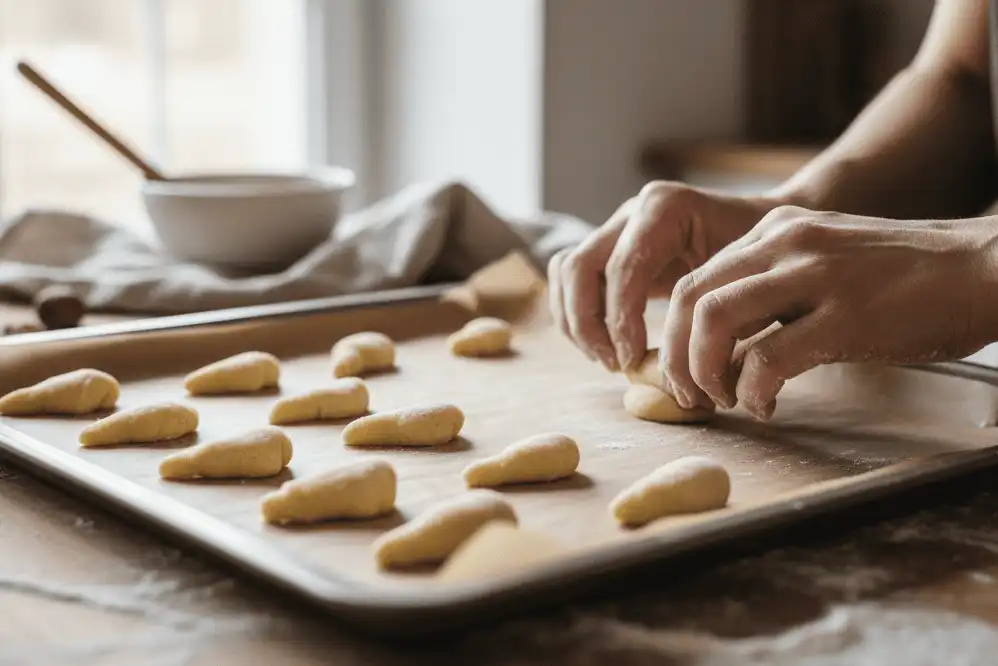
What: Delicate, eggless shortbread crescents rich in ground almonds and tossed in real vanilla sugar while warm.
Why: The complete absence of egg white creates a fragile, crumbly texture that melts on the palate instead of snapping.
Formula (Yield: 45 Crescents)
- 250g All-Purpose Pastry Flour (Type 405)
- 200g Cold Unsalted European Butter (82% butterfat), cubed
- 100g Finely Ground Blanched Almonds
- 80g Powdered Sugar, sifted
- 1 pinch Fine Sea Salt
- Coating: 100g Granulated Sugar mixed with 2 split Bourbon vanilla beans
Execution Steps
- Whisk the flour, ground almonds, powdered sugar, and salt in a chilled stainless steel bowl.
- Cut the cold butter cubes into the dry ingredients using a pastry cutter or fingertips until a crumbly meal forms. Press quickly into a cohesive dough without kneading.
- Shape into a flat disk, wrap in parchment paper, and refrigerate for a minimum of 2 hours.
- Divide the dough into four portions. Roll each portion into a rope 1.5 cm (0.6 inches) thick. Slice into 5 cm (2 inches) pieces.
- Roll each piece with tapered ends and bend into a crescent shape. Arrange on parchment-lined baking sheets with 2 cm spacing.
- Bake at 175°C (350°F) in a conventional oven for 10 to 12 minutes. The edges should be lightly golden while the tops remain pale.
- Rest the cookies on the sheet for precisely 90 seconds. While still warm, gently transfer them into the vanilla sugar bowl to coat completely.
Common Mistake: Moving cookies immediately out of the oven. Hot shortbread lacks structural integrity and will crumble instantly.
Pro Tip: Store your granulated coating sugar with split vanilla pods in a sealed jar for two weeks before baking to infuse the crystals thoroughly with natural vanilla oils.
Chewy Zimtsterne (Cinnamon Stars)
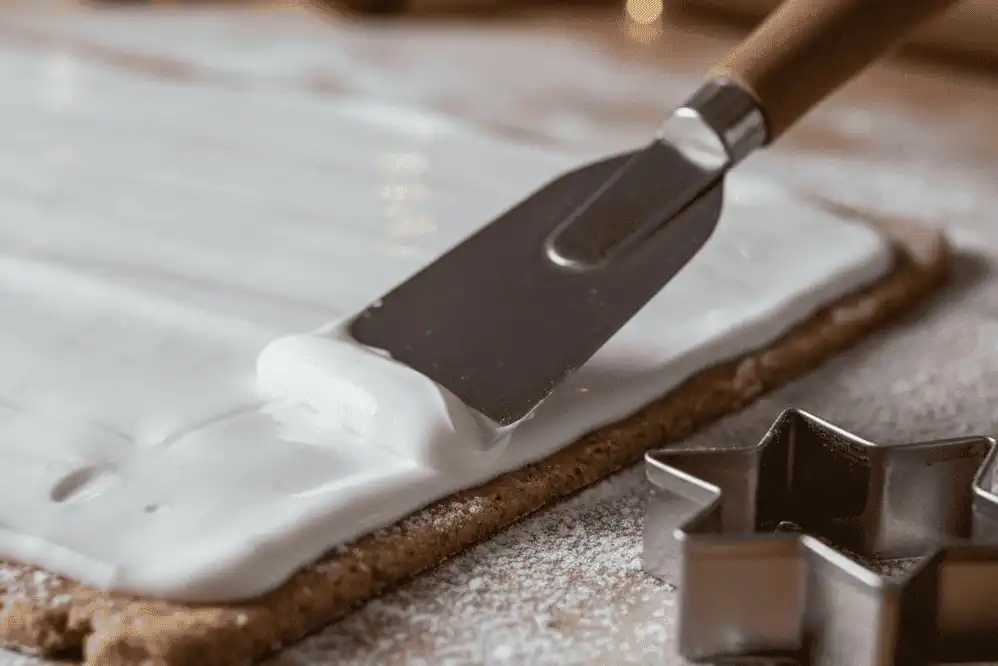
What: Naturally gluten-free star cookies made of spiced almond paste topped with a crisp, pure white meringue glaze.
Why: Reserving a portion of the whipped egg white base creates an integrated glaze that adheres permanently during baking without weeping.
Formula (Yield: 35 Stars)
- 3 Large Egg Whites (approx. 90g), room temperature
- 250g Powdered Sugar, sifted
- 1 pinch Fine Sea Salt
- 2 tsp Ground Ceylon Cinnamon
- 1 tsp Fresh Lemon Juice or Kirschwasser
- 380g Superfine Ground Blanched Almonds
Execution Steps
- Whip the egg whites and salt in a clean bowl until stiff peaks form. Gradually add the powdered sugar, beating until dense and glossy.
- Remove 4 tablespoons of this meringue mixture and reserve in a covered bowl for the top glaze.
- Gently fold the cinnamon, lemon juice, and ground almonds into the main meringue until a firm, pliable paste forms.
- Dust your counter generously with powdered sugar (do not use flour). Roll the dough to an even thickness of 8 mm (1/3 inch).
- Cut stars using a cutter dipped in powdered sugar. Place stars onto a parchment-lined baking sheet.
- Brush the reserved glaze evenly over the top of each star, pulling the glaze cleanly into the tips using a toothpick.
- Bake at 140°C (285°F) for 12 to 14 minutes. The meringue must stay bright white, and the bottom should just be set.
Common Mistake: Baking at high heat (180°C/350°F). Excessive heat browns the meringue and turns the chewy interior dry and hard.
Pro Tip: Wipe your star cookie cutter on a damp kitchen cloth between every two cuts to prevent sticky dough build-up from tearing the star points.
Nürnberger Elisenlebkuchen (Flourless Gingerbread)
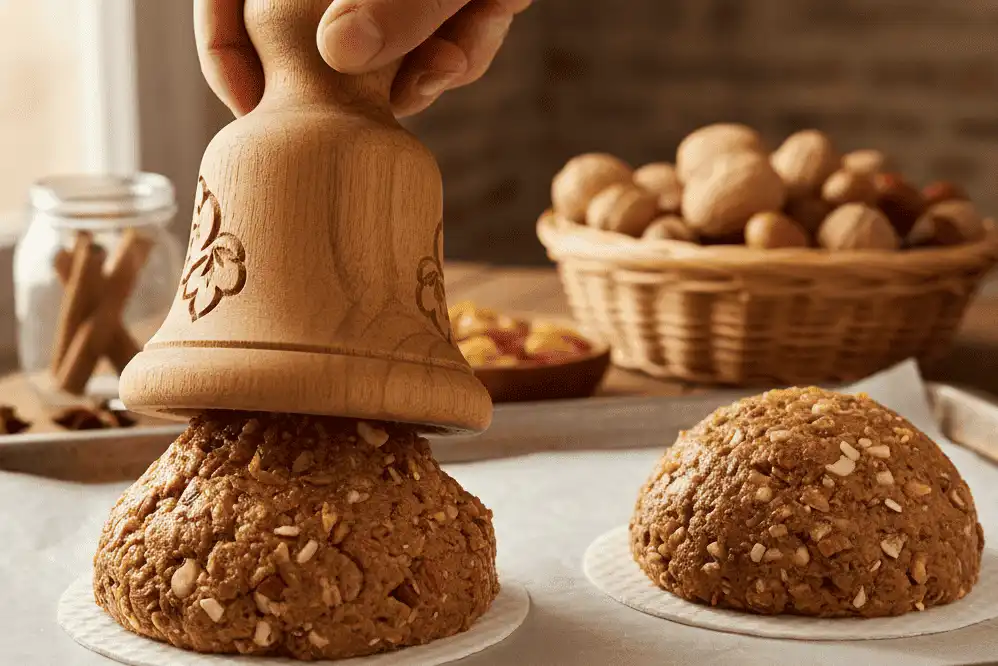
What: Luxury gingerbread rounds baked on edible wafer paper, featuring a high nut concentration and candied citrus peel.
Why: German food standards require Elisenlebkuchen to contain at least 25% tree nuts and no more than 10% grain flour. Premium recipes omit flour entirely for maximum moisture retention.
Formula (Yield: 20 Large Lebkuchen)
- 5 Large Eggs
- 200g Dark Muscovado or Raw Cane Sugar
- 2 tbsp Dark Forest Honey
- 2 tbsp Lebkuchengewürz (Spice Blend)
- 100g Candied Lemon Peel (Zitronat), pureed into a fine paste
- 100g Candied Orange Peel (Orangeat), pureed into a fine paste
- 250g Finely Ground Roasted Hazelnuts
- 200g Finely Ground Blanched Almonds
- 1 pinch Fine Sea Salt
- 20 Backoblaten (70mm diameter edible baking wafers)
- Glaze: 150g Dark Chocolate (70%) or warm boiled sugar glaze
Execution Steps
- Whisk the eggs, sugar, and honey on high speed for 5 minutes until pale, thick, and ribbon-like.
- Fold in the Lebkuchengewürz, pureed citrus peels, salt, hazelnuts, and almonds until fully incorporated.
- Let the batter rest at room temperature for 30 minutes to allow the nut meals to hydrate.
- Lay Backoblaten onto baking sheets. Mound 45g of batter onto each wafer, smoothing the edges into a dome using a wet spatula or a Lebkuchenglocke.
- Leave the unbaked rounds uncovered at room temperature for 90 minutes to dry the surface skin.
- Bake at 155°C (310°F) for 18 to 20 minutes until the edges are set but the center remains slightly soft.
- Cool completely on wire racks. Coat with tempered dark chocolate or brush with warm confectioner’s glaze.
Common Mistake: Leaving candied citrus peel in large chunks. Coarse chunks create localized dry spots and disrupt the tender crumb structure.
Pro Tip: Store baked Lebkuchen in a tin for at least 7 to 10 days before consuming to allow the spices and nut oils to mature fully.
Classic Spitzbuben (Linzer Jam Cookies)
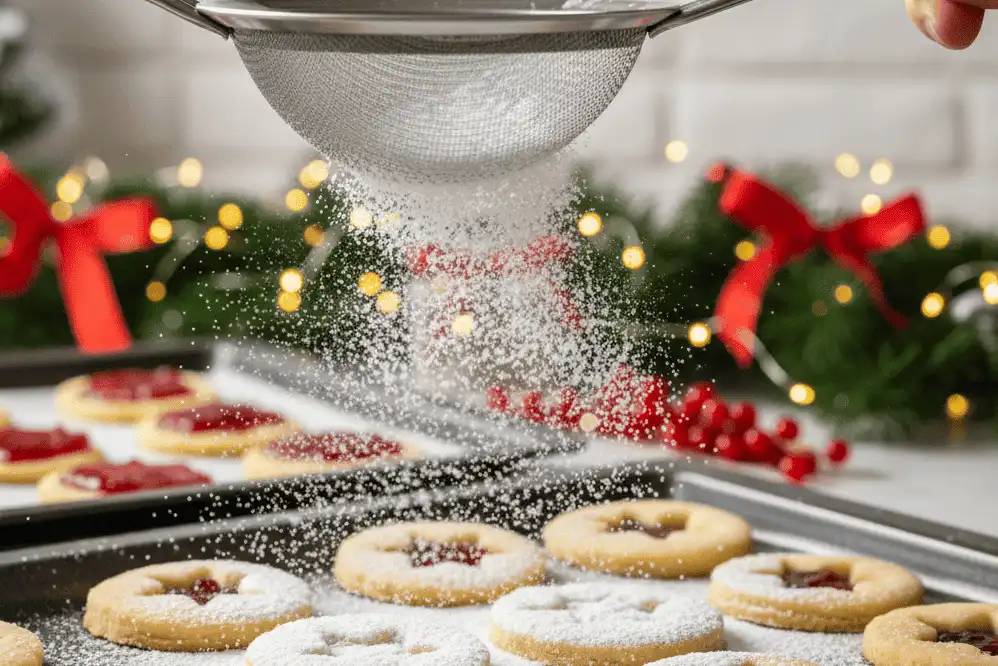
What: Crisp shortbread sandwich rounds filled with tart redcurrant jelly and finished with powdered sugar.
Why: High-acidity redcurrant jelly cuts the rich butter profile of the shortcrust pastry.
Formula (Yield: 24 Sandwich Pairs)
- 300g All-Purpose Pastry Flour (Type 405)
- 200g Cold Unsalted Butter, cubed
- 100g Powdered Sugar, sifted
- 1 Large Egg Yolk
- 1 tsp Pure Vanilla Extract
- 150g High-Pectin Redcurrant Jelly or Tart Raspberry Jam
Execution Steps
- Combine the flour, butter, powdered sugar, egg yolk, and vanilla into a smooth shortcrust dough. Chill for 60 minutes.
- Roll out the dough on a lightly floured surface to an even thickness of 3 mm (1/8 inch).
- Cut an equal number of solid base rounds and cutout tops with center holes using a 5 cm round cutter.
- Bake at 180°C (350°F) for 8 to 10 minutes until the edges are just barely golden. Cool completely on wire racks.
- Dust all cutout top pieces heavily with powdered sugar while they are still separate from the bases.
- Warm the redcurrant jelly in a small pan until fluid. Spoon half a teaspoon onto each base and sandwich with a sugar-dusted top.
Common Mistake: Dusting the assembled cookies with sugar. This covers the clear jam window in powdered sugar instead of keeping a sharp visual contrast.
Pro Tip: Warm the jelly before assembling. The hot pectin bonds firmly to the baked shortcrust, preventing the sandwich halves from sliding apart during storage.
Traditional Anise Springerle
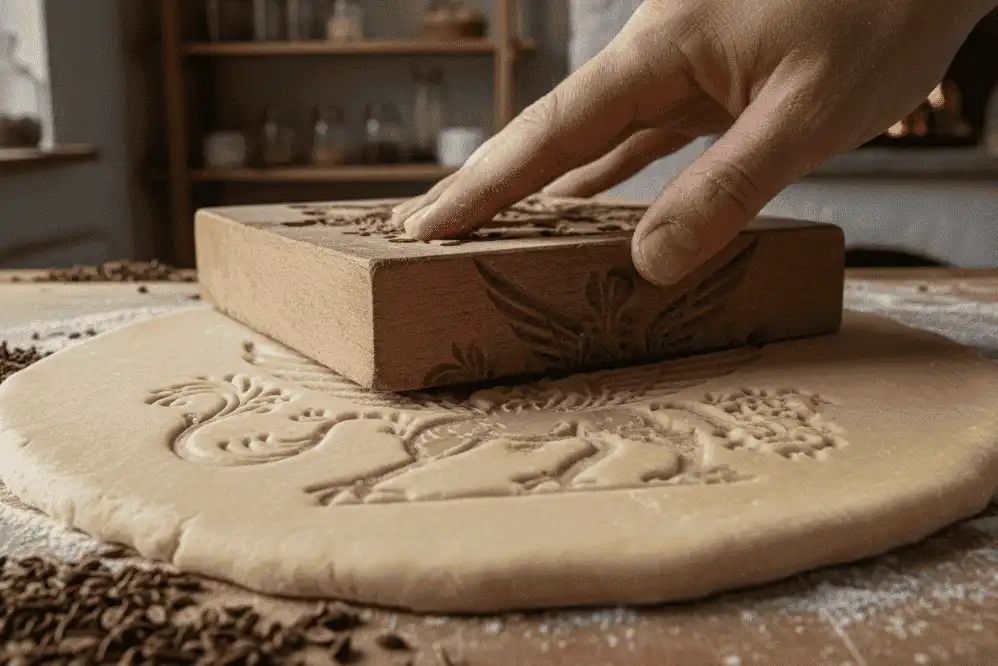
What: Traditional stamped anise biscuits with a firm embossed surface relief, a crisp bite, and a soft, cake-like interior.
Why: Drying the stamped dough for 24 hours sets the surface design, forcing steam downward during baking to create distinctive raised “feet” (Füßchen).
Formula (Yield: 30 Embossed Biscuits)
- 4 Large Eggs (approx. 200g), room temperature
- 400g Powdered Sugar, sifted
- 450g All-Purpose Pastry Flour (Type 405)
- 1/4 tsp Hirschhornsalz (Ammonium Bicarbonate)
- 1 tbsp Kirschwasser or Milk (to dissolve leavener)
- 2 tbsp Whole Anise Seeds (for scattering on the baking sheet)
Execution Steps
- Beat the eggs and sifted powdered sugar on medium-high speed for a full 15 to 20 minutes until pale, thick, and voluminous.
- Dissolve the Hirschhornsalz completely in the Kirschwasser or milk. Add to the egg mixture.
- Gradually fold in the flour until a firm, non-sticky dough forms. Wrap and chill for 30 minutes.
- Roll out the dough on a lightly floured surface to a thickness of 8 mm (1/3 inch).
- Dust a carved wooden Springerle mold lightly with flour. Press the mold firmly and evenly into the dough to transfer the relief pattern.
- Cut out individual cookies along the mold borders. Place onto baking sheets scattered with whole anise seeds.
- Leave the trays uncovered at room temperature in a dry room for 24 hours to dry the surface skin completely.
- Bake at 150°C (300°F) on the lowest oven rack for 15 to 18 minutes. The tops must remain pale white while the base develops small raised feet.
Common Mistake: Baking immediately without drying. Skipping the 24-hour rest causes the surface design to melt and blur during baking.
Pro Tip: Dissolve your Hirschhornsalz thoroughly in liquid before adding. Undissolved granules leave tiny yellow spots and bitter flavor pockets in the finished biscuit.
German Christmas Cookie Comparison Matrix
| Variety | Dough Family | Primary Leavener | Texture Profile | Maturation Time | Shelf Life |
|---|---|---|---|---|---|
| Vanillekipferl | Nut Shortcrust | None (Steam only) | Tender, crumbly melt | 3 to 5 Days | 3 to 4 Weeks |
| Zimtsterne | Nut Meringue | Egg White Foam | Chewy, marzipan-like | 1 to 2 Weeks | 4 to 6 Weeks |
| Elisenlebkuchen | Spiced Nut Batter | Whipped Whole Eggs | Moist, dense, soft | 2 to 3 Weeks | 8 to 12 Weeks |
| Spitzbuben | Classic Shortbread | None / Minimal Powder | Crisp with jam softness | 2 to 3 Days | 2 to 3 Weeks |
| Springerle | Dense Egg Dough | Hirschhornsalz | Crisp shell, cake center | 3 to 4 Weeks | 3 to 6 Months |
| Pfeffernüsse | Spiced Honey Dough | Pottasche | Firm with sugar shell | 2 to 3 Weeks | 8 to 12 Weeks |
The Science of Cookie Aging and Tin Management
Traditional German cookies are designed to mature over time rather than being eaten immediately from the oven. Moisture migration and spice equilibration in sealed environments are critical to achieving authentic textures.
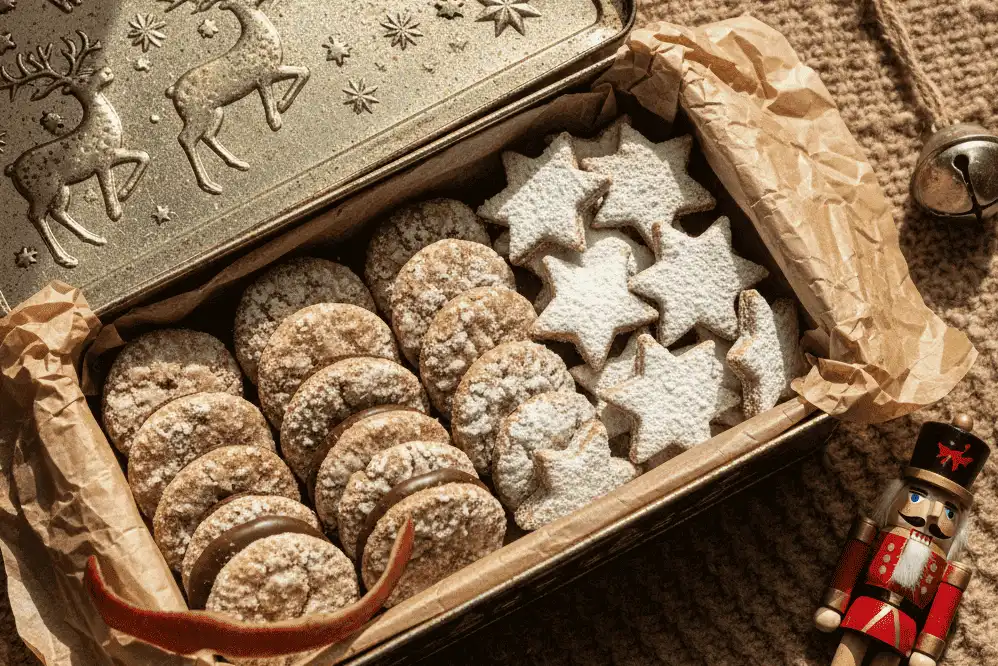
The Metal Tin Rule
Never store traditional German cookies in airtight plastic containers. Plastic traps humidity and softens crisp shortbread coatings while altering delicate spice aromas.
Use embossed metal biscuit tins (Blechdosen) lined with parchment paper. Metal tins allow micro-exchange of air while shielding cookies from light and major humidity shifts.
Separation of Flavors and Moisture Profiles
Never mix different cookie styles in the same tin. Moisture from soft honey cookies like Lebkuchen will migrate into crisp shortbreads like Vanillekipferl, turning the shortbread soggy and causing the gingerbread to dry out.
Strongly spiced cookies (like Pfeffernüsse) will also transfer their clove and pepper aromas into delicate vanilla shortbreads within 48 hours of co-storage.
The Apple Peel Moisture Technique
If dense honey-based cookies like Pfeffernüsse or Springerle remain too hard after baking, place a fresh strip of raw organic apple peel on parchment paper inside the tin for 48 hours.
The cookies absorb the moisture released by the apple peel, softening their crumb. Replace the peel every two days to prevent mold development.
Troubleshooting and Common Baking Pitfalls
Problem: Zimtsterne spread flat and lose their star points during baking.
Root Cause: The egg white meringue had too much moisture or the dough was rolled with wheat flour. Flour breaks down the nut-paste structure. Always dust your rolling surface with sifted powdered sugar, and fold in extra ground almonds if your dough feels wet.
Problem: Springerle images melt or blur into smooth biscuits.
Root Cause: The biscuits did not dry long enough before baking. Springerle must dry for a full 24 hours at room temperature to form a chalky, hardened surface crust that preserves the stamped relief in the oven.
Problem: Vanillekipferl crumble into pieces when transferred from the pan.
Root Cause: Handling the crescents while they are straight from the oven. Eggless butter shortbread has zero tensile strength while hot. Let them rest for 90 seconds on the pan to stabilize before coating.
The Professional Holiday Baking Schedule
To prepare an authentic German Bunter Teller without kitchen stress, organize your baking across the four weeks of Advent based on required aging times:
- Late November (4 Weeks Before Christmas): Bake Springerle and dense honey Lebkuchen. These varieties need three to four weeks of resting in metal tins to develop their ideal textures and aromas.
- First Week of Advent (3 Weeks Out): Bake Pfeffernüsse, Stollen, and Bethmännchen. This gives spice blends time to equilibrate with almond pastes and honey.
- Second Week of Advent (2 Weeks Out): Bake Zimtsterne and Elisenlebkuchen. These nut-rich pastries reach peak flavor and chewiness after 10 to 14 days in storage.
- Third Week of Advent (1 Week Out): Bake delicate butter shortbreads, including Vanillekipferl, Spitzbuben, and Heidesand. These are best enjoyed within one to two weeks of baking.
Specialty Tools and Equipment
- Digital Gram Scale: German baking relies on precise weight ratios rather than volume cups. A digital scale with 1-gram accuracy is essential.
- Carved Wooden Springerle Molds: Hand-carved pearwood or cast resin molds with traditional reliefs are required to imprint Springerle dough.
- Lebkuchenglocke (Gingerbread Bell): A turned wooden dome with an integrated sweep wire that quickly forms uniform Lebkuchen mounds directly on Backoblaten.
- Heavy-Gauge Aluminum Baking Sheets: Thick, light-colored pans prevent the bottoms of delicate cookies like Zimtsterne and Springerle from over-browning.
- Embossed Tin Boxes (Blechdosen): Food-safe metal tins protect stored cookies from humidity swings, ambient odors, and direct light.
Recommended Internal Reading
- The Master Guide to Traditional Dresdner Christstollen
- How to Make Authentic Marzipan from Raw Almonds
- German Flour Types Explained: Type 405, 550, and 1050
- The Science of European Butter: Butterfat Ratios in Pastry
- Traditional German Yeast Dough (Hefeteig) Masterclass
Authoritative Culinary Standards
- German Food Code (Deutsches Lebensmittelbuch): Statutory standards and legal composition thresholds for Nürnberger Lebkuchen and fine baked goods.
- State Museum of Württemberg: Historical archives documenting regional Swabian Springerle mold artifacts from the 16th to 19th centuries.
- Guild of Nuremberg Gingerbread Bakers: Protected Geographical Indication (PGI) regulatory standards for authentic Elisenlebkuchen production.
Key Takeaways
- Bake using metric gram measurements to maintain proper fat and nut-flour ratios.
- Match traditional leaveners to dough density: Hirschhornsalz for crisp biscuits and Pottasche for heavy honey doughs.
- Control oven temperatures carefully. Nut-meringue cookies require low heat to preserve their color and chewiness.
- Store cookie varieties in separate, parchment-lined metal tins to prevent moisture transfer.
- Follow a four-week baking schedule to give spiced pastries adequate time to mature before serving.
Bake Your Own Authentic German Christmas Cookies
Authentic German Christmas cookies bring centuries of European culinary heritage into your home kitchen. By using traditional leaveners, blending fresh spices, and managing storage times carefully, you can produce a festive Bunter Teller that matches the finest bakeries in Nuremberg and Munich.
Frequently Asked Questions
What makes German Christmas cookies different from American holiday cookies?
German Christmas cookies feature a much higher proportion of ground tree nuts, minimal grain flour, and distinct warm spices like cardamom, mace, and cloves. They also use specialized leaveners like Hirschhornsalz and Pottasche instead of baking powder, creating unique textures and allowing for extended storage maturation in tins.
Can I substitute baking powder for Hirschhornsalz or Pottasche?
Baking powder can provide a general rise in an emergency, but it cannot replicate the specific chemical results of traditional leaveners. Hirschhornsalz produces a crisp snap without vertical puffing, while Pottasche encourages horizontal spread and chewiness in dense honey doughs. Substituting baking powder alters the traditional texture.
Why do traditional German cookies need to age in tins for weeks?
Dense honey- and nut-based doughs like Lebkuchen, Pfeffernüsse, and Springerle need time for moisture to redistribute evenly through the crumb. Aging also allows complex essential oils from the spice blend (cinnamon, clove, allspice) to mellow and fully infuse the cookie.
How do I prevent my Vanillekipferl from breaking when dusting them?
Vanillekipferl contain high amounts of butter and no egg binders, making them fragile when hot. Let them rest on the baking sheet for approximately 90 seconds after removing them from the oven. This allows the butter to set slightly before you gently dredge them in vanilla sugar while warm.
Why are my Zimtsterne hard instead of chewy?
Zimtsterne turn hard when baked at excessive heat or for too long. Bake them at a low temperature (around 140°C or 285°F) for only 12 to 14 minutes. The bottoms should just be set while the centers remain moist and marzipan-like upon removal from the oven.
What are Backoblaten and why are they used?
Backoblaten are ultra-thin, unsweetened edible wafers made from wheat flour, starch, and water. They provide a stable, non-stick base for soft, sticky nut batters like Elisenlebkuchen, preventing them from sticking to the baking tray while giving clean structural support.